

Chat Control, Exactly How It Sounds
The European Union's (re)attempt to surveille all European communication

The European Union’s proposed child sexual abuse regulation (CSAR), colloquially known as ‘Chat Control,’ was initially introduced for consideration in November 2022 and is again under consideration for adoption as of August 2025.
Chat Control is proposed as an attempt to combat child exploitation on a large scale by proactive scanning of European citizens’ communication mediums to stop the spread of child sexual abuse material (CSAM) and intervene in grooming conversations before harm happens. Similarly, the United States has proposed the Kids Online Safety Act (KOSA) and the UK has implemented the Online Safety Act 2023 (OSA). Unsurprisingly, both KOSA and OSA have been discovered to not actually aim to protect children online but rather censor and control open speech online. This became apparent with Senator Marsha Blackburn (R) stating that KOSA would be utilized to limit and censor speech relating to transgender lifestyle and education and Ofcom1 officials stating that the OSA regulation was was “not primarily aimed at … the protection of children”, but instead was about regulating “services that have a significant influence over public discourse.” One can assume that Chat Control will become nothing more than legislation to further online censorship in the same vein as the KOSA bill and OSA regulation.
The Chat Control legislation is expected to crack down CSAM by implementing indiscriminate client-side2 scanning of all private messages. This would mean that the European government will place scanners on all citizens’ devices in order to surveille all text, audio, image, and video messages before they’re sent. The legislation describes the use of AI to review all data collected for flaggable content. Even more alarmingly, this scanning will include encrypted messaging services such as Signal and Telegram. This will result in a process that defeats the purpose of end-to-end encryption (E2EE) as the data will be collected and stored before it can go through the desired encryption processes, a clear privacy risk.
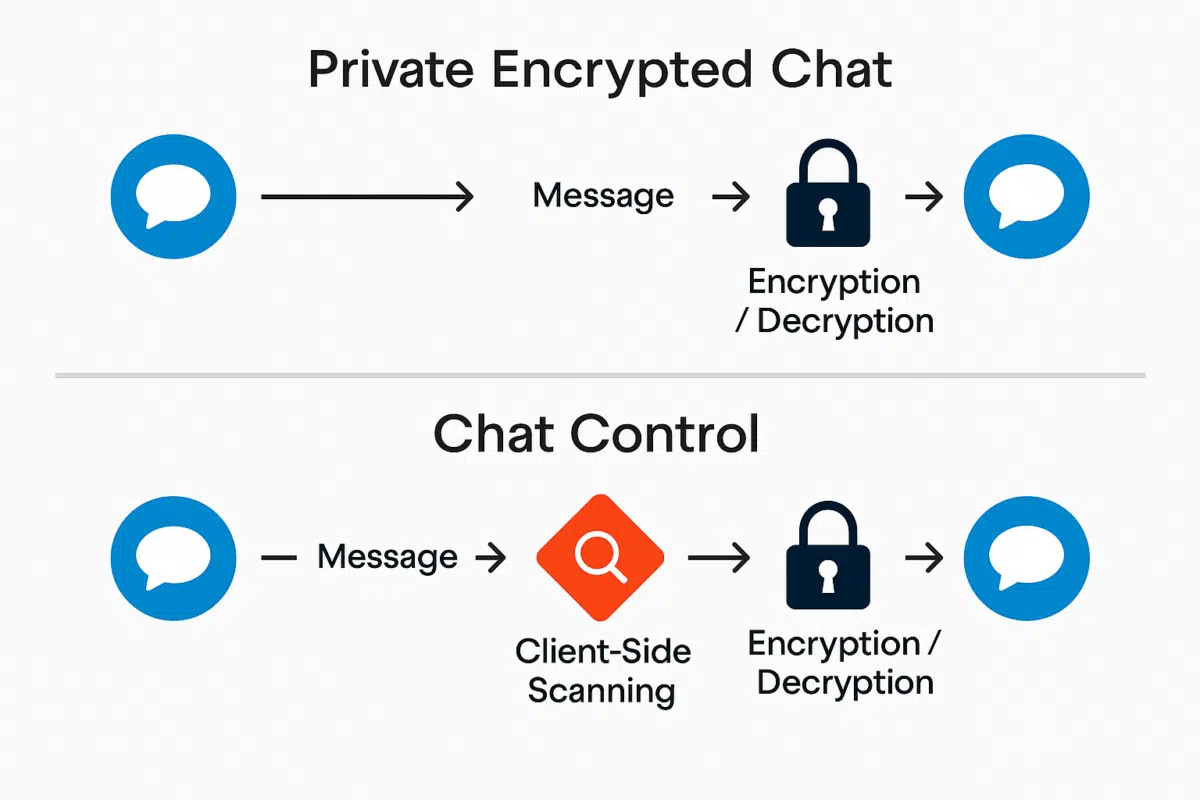
Conveniently, European politicians have exempted themselves from this scanning and surveillance under “professional secrecy” rules.
This legislation also directly infringes on The Fundamental Rights of the European Union, specifically Title II Articles 7 and 8.
Article 7
Respect for private and family life
Everyone has the right to respect for his or her private and family life, home and communications.
This legislation clearly has no regard for European citizens’ privacy of communications as scans will be indiscriminate, no degree of reasonable suspicion or probable cause will be necessary to collect private messaging data.
Although the explanation of Article 7 does describe reasonable interference of this right when necessary for public safety or protection of others similar legislation has already set a precedence for nefarious use of surveillance technology in the name of “protecting children.”
There shall be no interference by a public authority with the exercise of this right except such as is in accordance with the law and is necessary in a democratic society in the interests of national security, public safety or the economic well-being of the country, for the prevention of disorder or crime, for the protection of health or morals, or for the protection of the rights and freedoms of others."
It is reasonable to assume that this technology will quickly be utilized to identify persons of interest for various governments and censor or silence dissenting voices.
Article 8
Protection of personal data
1. Everyone has the right to the protection of personal data concerning him or her.
2. Such data must be processed fairly for specified purposes and on the basis of the consent of the person concerned or some other legitimate basis laid down by law. Everyone has the right of access to data which has been collected concerning him or her, and the right to have it rectified.
3. Compliance with these rules shall be subject to control by an independent authority.
Article 8 addresses the right to the protection of personal data, which is not possible when all personal messaging data is indiscriminately recorded, collected, and analyzed without probable cause. European citizens are also unable to consent to this scanning as it is required on all message-capable devices. To argue that European citizens consent by way of using digital messaging-capable devices is to argue in support of coercion as digitally enabled devices such as cell phones become increasingly necessary to be a functional member of society in the digital age.
This degree of surveillance is an abuse of power pushed by politicians whom have exempted themselves from being exposed to the same degree of constant monitoring. If European officials believe this is an efficient way to stamp out CSAM and address online grooming then let them be the first to experience constant surveillance to prove how effective it can be. Let them weed out who amongst themselves are predators and bring their abusive actions to light in a display of solidarity with the working class. Perhaps this would’ve been an effective way to identify child sex abusers in the highest positions of office more quickly, like former minister Henrik Sass Larsen who is sentenced to 4 months in prison for possession of 6,000 photographs and 2,000 videos of CSAM.
Chat Control is legislation that infringes on European citizens’ rights to privacy and protection of personal data. Similar legislation acts as a precedent to safely assume bills of this kind will quickly be abused as tools for censorship. Citizens should act quickly to ensure this bill and bills similar to it do not pass within governments or risk further loss of privacy online.
Consider visiting the Fight Chat Control Website by clicking here.
Know your rights, read The Charter of Fundamental Rights of The European Union by clicking here.
For more information consider watching EU Made Simple’s video Chat Control Explained - The EU’s Plan to Read YOUR Messages
Disclaimer: the information in this post reflects my thought(s) and opinion(s) on the subject being discussed at the time of posting. These thoughts and opinions are subject to change at any time. Factors that may play a part in changes may include change(s) in world view, additional research, more accurate research, open discussion, etc.
Ofcom is the UK regulator responsible for implementing and enforcing the Online Safety Act
Client-side refers to your personal device including cell phones, computers, etc.